Feeling Emotions in Your Body (with the Emotion–Sensation Wheel)
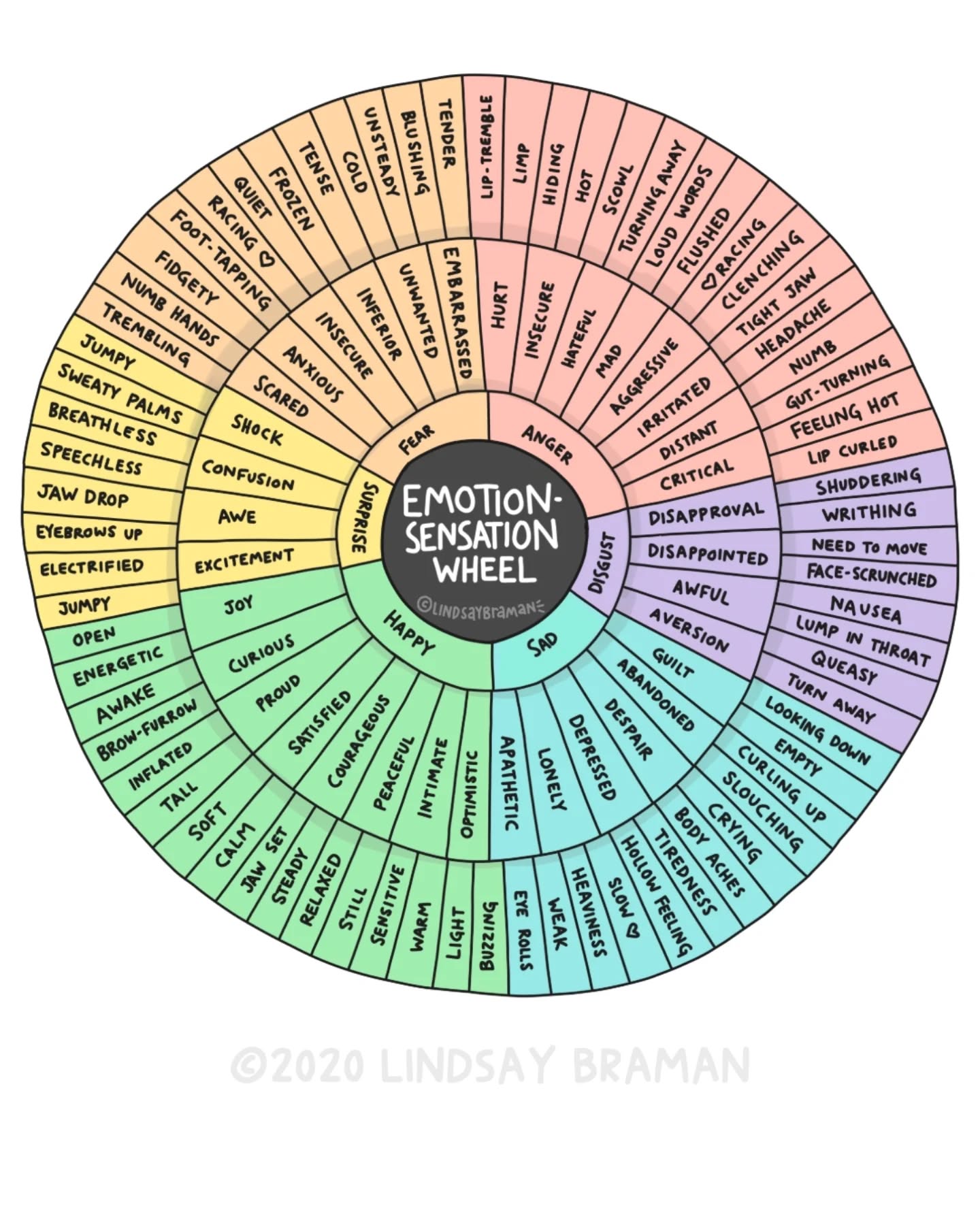
When you have an emotion, your body usually changes—breathing, heart rate, muscle tension, temperature, posture, face, etc. Learning to notice those signals makes emotion regulation easier.
If you've spent years "shutting off" body sensations (for safety, trauma, chronic stress, masking, sensory overwhelm), reconnecting can feel hard at first—but it's a learnable skill.
Neurodivergent note (important)
If you're autistic and/or ADHD, you might have interoception differences—meaning it can be harder to notice or interpret internal signals (like hunger, thirst, rising anxiety, or anger building). Dr. Emma Goodall describes interoception as the internal sensory system that helps you notice, recognize, and respond to body states, and notes that overwhelm and trauma can reduce access to these signals.
Research on the Interoception Sensory Questionnaire (ISQ) also suggests many autistic adults report "interoceptive confusion."
So if this is difficult: it doesn't mean you're "doing it wrong." It means your nervous system may need smaller steps and more supports.
Step-by-step: Find the emotion through your body (using the wheel)
Step 0 — Safety + choice (10 seconds)
Ask yourself: "Does checking inside feel safe enough right now?"
- If no: start with external mindfulness (look around the room, name 5 things you see), then come back later.
- If yes or maybe: continue, but keep it small. (You can stop anytime.)
Step 1 — Start with a baseline body question (20 seconds)
Instead of "What emotion am I feeling?", try:
- "How do I know I'm okay or not okay right now?"
- "What signals is my body giving me?"
Pick one easy signal to check:
- stomach (empty/full/nausea)
- throat (tight/lump/clear)
- chest (tight/open/neutral)
- jaw (clenched/loose)
- hands (restless/tingly/still)
If you can't tell: that's still data. Write: "unclear".
Step 2 — Use supports if interoception is fuzzy (optional, ND-friendly)
External supports are valid. They can bridge the gap while your internal awareness grows.
Try one:
- glance at a smartwatch heart rate (if you have one)
- check room temperature / weather app to notice heat/cold
- drink water if you realize you haven't in a while
- use a timer prompt ("pause + body check" 1–2x/day)
Goodall also describes building interoception with brief body-awareness activities practiced regularly over time.
Step 3 — Do a micro-scan (30–60 seconds, not a full body scan)
This is a gentle "sip," not a "chug."
- Shoulders: up to ears → drop them
- Hands: open/close once
- Feet: press toes into the floor, then relax
- Breath: one slow exhale
You're looking for any change: tight/loose, buzzy/heavy, hot/cold, still/restless.
Step 4 — Face-first check (often easiest to notice)
DBT materials note that facial expressions and body language are tightly linked with emotion.
Check these quickly:
- jaw: clenched / loose
- eyes: wide / squinty / avoiding
- forehead: tense / smooth
- mouth: tight / trembling / downturned
- throat: tight / open
If you find tension, soften one area (jaw or forehead) and see if anything shifts.
Step 5 — Use the Emotion–Sensation Wheel (the image on your screen)
You'll move outside → in.
5A) Pick 1–2 body sensations (outer ring)
Look at the outer ring and choose what matches closest.
Examples: tight jaw, racing, nausea, heavy, lump in throat, sweaty palms, shuddering, numb.
5B) Move one ring inward: choose the matching emotion word
From that slice, pick the emotion word that fits best (even if it's only 60% right).
5C) Move to the core emotion family (center ring)
Choose the core family:
Fear / Anger / Sad / Happy / Disgust / Surprise
5D) Rate intensity (0–10)
"How strong is it right now?" ____/10
If you pick the "wrong" one: totally fine. Your goal is "close enough to work with."
Step 6 — "Name + locate" (the DBT move)
Write one simple sentence:
"I'm noticing ___ (emotion) in my ___ (body place), at about ___/10."
Example:
"I'm noticing anxious in my chest and hands, about 6/10."
This is mindfulness "Describe" in DBT—labeling without judgment.
Step 7 — If you feel stuck, use the "urge + posture" shortcut
Sometimes you can't feel the emotion, but you can notice the urge.
Ask:
- "Do I want to hide/escape?" (often Fear)
- "Do I want to attack/argue?" (often Anger)
- "Do I want to withdraw/cry/sleep?" (often Sad)
- "Do I want to push away/clean/get away?" (often Disgust)
- "Do I want to move toward/connect/celebrate?" (often Happy)
Then use the wheel to see which slice matches your urge + any small sensation.
Step 8 — Tiny regulation option: Half-Smile (only if it feels okay)
Researchers and DBT sources note that changing facial muscles can shift emotional intensity for some people—this is why DBT teaches Half-Smile.
Try for 10 seconds:
- relax your face
- gently lift the corners of your mouth slightly (not a fake big smile)
- breathe out slowly
Then re-rate intensity: ____/10
(If this feels invalidating or weird, skip it.)
Step 9 — Close the loop (pick one "next right step")
Now that you have a label, choose one:
- "I can sit with this feeling." → Emotion Exposure / Self-Validation / Self-Compassion / Core Belief
- "This is too big right now." → Distress Tolerance (STOP/TIPP)
- "This is about a situation with someone." → Interpersonal Skills (DEAR MAN / GIVE / FAST)
- "My body needs basics." → Self-care check (hydration/food/meds/rest)
If your body feels "blank" or "numb"
That counts as information too. Try:
- write: "numb / unclear"
- use external anchors (sound/sight) for 30 seconds
- do one micro-scan movement (toes or shoulders)
- then try the wheel again from the outer ring
Over time, repeated short practices (not long intense ones) can build interoceptive awareness.